Protests took place in Tel Aviv, Jerusalem, Haifa, and Beersheba, as a survey found broad but uneven support among Jewish Israelis for Operation Roaring Lion.
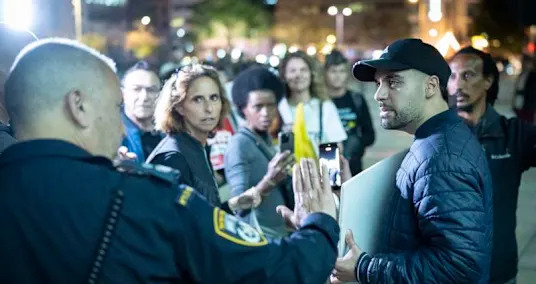
Israel Police arrested 21 anti-war protesters Saturday night as demonstrations against the conflict with Iran expanded in multiple cities despite restrictions on public gatherings.
Protests took place in Tel Aviv, Jerusalem, Haifa, and Beersheba, with hundreds of participants reported in Tel Aviv and Jerusalem and about 100 in Haifa, marking the largest turnout since weekly demonstrations began. Authorities said 13 people were arrested in Tel Aviv and eight in Haifa.
Police said the gatherings were not approved under Home Front Command regulations that ban events with more than 50 people. Officials said the increase in turnout followed calls by groups opposing the government to protest despite the restrictions.
“During a situation assessment that took place at the scene with a Home Front Command representative… it was clarified that there was a real risk to human life and accordingly, Yarkon [precinct] police commander Tzachi Sharabi ordered the gathering to be dispersed,” police said.
Hadash-Ta’al chairman Ayman Odeh, an Arab lawmaker involved in the protests, criticized the police response, calling officers fascists “in the service of the government” and saying they were afraid of “the heroic citizens who went out, despite everything, to make their voice heard.”

Survey shows broad, uneven support for war
The demonstrations come as a March 2026 survey by the Israel Democracy Institute found broad but uneven support among Jewish Israelis for Operation Roaring Lion. Support was strongest on the Right at 87% and about half on the Left.
The survey also found that Jewish and Arab respondents largely agreed that Iran’s resilience has been stronger than expected. Most Jewish respondents said Israeli society could sustain the campaign for up to one month, while 28% said as long as needed. Arab respondents were less optimistic about how long the public could endure the conflict.
A majority of Jewish respondents said Prime Minister Benjamin Netanyahu’s decision was driven by security considerations, while most Arab respondents viewed it as political.
LATEST POSTS
- 1
 A Gustav Klimt painting is now the most expensive piece of modern art sold at auction. The fascinating history behind the $236 million 'Portrait of Elisabeth Lederer.'
 - 2Key Business Regulations to Consider While Arranging Your Independent venture
- 3A24's 'Backrooms' trailer shows endless fluorescent-lit spaces and terrifying mannequins melting into the floor
- 4Well known Worldwide Caf\u00e9s to Experience
- 5Instructions to Keep an Inspirational perspective After Cellular breakdown in the lungs Treatment





- Southern Californians, your health insurance costs could rise in 2026
- Brazil's Bolsonaro to continue his sentence at home because of poor health
- Meet the Stars of the Feline World: Well known Pet Feline Varieties
- Bother Control Administrations for 2024: Decide for Your Home
- Washington resident is infected with a different type of bird flu
- Spain and Catholic Church agree to compensate sex abuse victims
- Hunger and makeshift shelters persist in north Caribbean nearly 2 months after Hurricane Melissa
- Interoceanic Train derails in southern Mexico, injuring at least 15 and halting traffic on line
- Agios Pharma shares jump as US FDA expands approval for its blood disorder drug